Showing posts with label Hints and Tips. Show all posts

30 September 2013

Be prepared Pt 2, Bait

In this part I am going to look at the preparation and care of baits that I use on a regular basis, I am going to look at each type of bait in turn starting with live baits.

Now by live baits I am not talking about small fish but thing like worms, maggots and casters, I am going to start with worms as these are pretty easy to look after.

Dendrobenas:  These usually come supplied in a hessian sack when you buy a 1/2KG or more and this is the perfect container top store the worms in as it allows them to breathe naturally and also with a little bit of thought it is possible to keep them alive in the medium provided for up to a month.  The best tip I have been given is to feed them cold mashed potato as it keeps them big and juicy for longer. For storage a cold concrete floor out of direct sunlight i.e. a garage floor should be fine, just don’t let them freeze in the winter!

Lobworms: These are a slightly trickier animal to deal with in that I tend to collect them upto 2 nights before I fish with them, I will then store them in soil and cut grass until the match making sure to keep them cool but not cold. Check them regularly for dead or broken worms and that way you should be able to extend their life for a couple of days. As I say though I very rarely try to keep them for longer than 48hrs as I have been unable to extend their life in a bait tub for any real length of time, this winter I will be trying a worn sack though. I will keep you updated.

Maggots and Pinkies: These are so similar that I am going to cover them in the same paragraph, put them in a bait tub with about an inch to the top and stick them in a fridge, like this they should be good for about a week.  This can be used to your advantage as well especially when fishing for small fish (especially Bleak) as the skin of the maggot will get tougher and therefore they should stay on the hook for longer, the maggots also build up a resistance to the cold so they should be livelier for longer in cold water.  I also like to de-grease my maggots when I am fishing on running water as it helps them to sink faster, the way that I do this is by cleaning all the sawdust/ maize from the maggots, and then I riddle off all the dead, casters and large rubbish. Once this is done I will add a really good quantity of turmeric to the maggots, this not only removes the grease from the maggots making them sink quicker but also gives white maggots a subtle bronze colour that big Roach love.  I will leave this in the fridge overnight before the match, and then as I am sorting my bait I will riddle off all the excess turmeric (this prevents you from turning very orange).

Dead Maggots: There is only one way that I use to numbers of maggots and that is to riddle them clean, put them into a plastic bag, add a flavour if I am going to then I put them into the freezer for 24-48 hrs. This produces much better dead’s than boiling them as they keep their shape and colour for longer. If however I only need 1 or 2 at a time then I will rub them against my thigh whilst fishing, and that provides me with hook baits when I want a change.

Squatts:  These are the larvae of the common house fly and as such they are considerably smaller than normal maggots and pinkies, sometimes they come from the shop and they are positively tiny, as long as you get your bait a couple of days in advance I have a tip that can give you some of the biggest squats on the bank, feeding them.  This was shown to me on my first national and it has never left me (thanks Gaz the bait man), it is simple but I have tweaked it slightly to try and get the best results with minimal fuss.  I will usually have a pint of squatt for a normal canal match, the first thing that I do is sieve off all the brick dust that they will be stored in, this is to be saved for later. The next step is to riddle them into a shallow tray, whilst they are going through the riddle I will prepare their banquet. Bread and milk is all that you need I tend to soak the bread in the milk until it is properly sodden all the way through and tries to fall apart as you lift it, a good tip here is to use milk at room temp as too cold and it will affect the squats appetite.  Once the squatt are riddled and the bread soaked, I place the bread into the squats and leave them to it, I will keep a bit of an eye on them as they can climb out of the tray of they are wet so beware. I will leave them for as long as possible as the more they eat the bigger they get, about 3 slices of bread should be enough for a pint of squatt but experiment and if they will eat more then why not give it to them, I have tried 6 slices before on a good batch and some of them ended up the size of pinkies! Once they have eaten all the bread or you have run out of time, chuck them back through the riddle and then put them back into the brick dust and into the fridge. Storage wise, keep them in the brick dust and dampen it slightly to prevent them from shrivelling up too much, the colder the better (but not freezing) as they will go into suspended animation and not get any smaller.

Casters: I always use shop bought caster, but not every shop knows how to turn their own or how to look after them, I use 2 shops in my local area, Premier Angling in Chippenham and Reids Tackle at Witherington Farm.  I will think nothing of going on a 2hr round trip if it will get me the best quality bait for a competition.  Things to avoid are small dark casters as these will probably all float and if they are supplied in a vacuum packed clear bag as this causes bag burn. You need a good mix of colours light to dark and the gold standard is casters that are given to you wrapped in a paper bag inside a sealed plastic bag as these will not suffer from Bag Burn. If you are concentrating on carp then it is not as important, but confidence in your bait means that you will have more confidence on the bank and this can only help you catch more fish.

That’s it for live baits, there are probably more but I am struggling to remember them, I am now going to move onto particles starting with my favourite.

Hemp: I will cook up bulk lots of hemp from time to time, usually doing 6-8 pints at a time, I do it the normal way, big pan soak for 24hrs and then simmer until the kernels start to split. Simple. There are a couple of things that you can do to increase the potency of your hemp for carp fishing and it involves me putting my Speci Hunter hat on, Chilli and salt are both added to my carp batches as I have more confidence in it pulling the fish from further away.  If I am carp fishing you will usually find hemp somewhere in my kit as just through the noise of one fish feeding on it make one hell of a racket under water and will draw fish in from quite a distance. Try that with soft pellet!  For roach I will freeze the hemp into 1 pint bags and take a couple every time I go fishing, hook baits are a different kettle of fish though, before I bag up the batches I will sort through and select some grains that are only just starting to split, These are separated into another tub and I will pierce the flat end of the grain to aid hooking. Hooked in this way a grain of hemp can stay on the hook for upto 10 fish, something that you cannot do when hooking then the traditional way through the split.


Tares: I try to find shop ready tares wherever possible, the best come in a small green bag and I forget their name but they are perfect.

Sweetcorn: This is the easiest bait that I use, open the tin, pour into bait tub and then cover with water, if I fancy giving it a kick then I will add a flavour or some salt to it in the bait tub.

Meat: For feed I use Morrison’s own brand and a MAP meat cutter in 6,8 and 10mm depending on the venue and size of carp that I am targeting, I will rarely do anything to the loose feed meat apart from store it in the fridge at home and on the bank I will cover it in plenty of water, on hot days it sometimes pays to only put a small amount on your tray at a time and top it up throughout the day as it can go off in the sun.  Meat for bomb hookbaits is a different prospect, I will take a tin, thickly slice it and then use a multitude of different sized punches to get different sized pellets of meat. I then split them down into small re-sealable bags and then flavour the meat in different ways. The fun part of this is finding out the best flavours so I am not going to spoil that for you.

Pellets, both expander and soft can be prepped on the bank, the only time I really prep my pellet the night before is if I want mushy feed pellet, I will take ¼- ½ a pint of 4mm pellet and cover item with an extra half an inch of water sat on top of them, put it in the fridge overnight and in the morning you will have sloppy pellet, perfect for hard days in the winter.

Groundbait for roach and small fish is best mixed on the bank, if however, you are after bream or other big fish then the longer you can let the bait rest the better as it creates an inert bed of feed for them to graze over. I will mix my bream groundbait the night before and it usually consists of 50/50 Browning Etang and Betaine Mussel mix, although the colder it gets the less fishmeal I put in and I will swap the Betaine mussel mix for No1 or Canal. Top tips when using ground bait is always use a drill!  I have found nothing better when mixing 4-5kg of groundbait and leam together, make sure that it has enough guts to do the job and that the whisk will get into the corners of the bucket that you use. If you do not have a drill then be prepared to riddle it a couple of times to get it to do the job you want.


So that’s it, I am going to save some bits for another day, but if you have any questions then please by all means drop me a line and I will try to answer it. Until the next time, tight lines.

22 September 2013

Being Prepared pt1

So I am sat here waiting for time to speed up and for me to be able to get home and I am thinking about all the things that I need to do when I get home, now some I am not going to share with you, but I am going to cover the sort of preparation that I go into before a match.
I am going to start with some of the general stuff and let’s look at hardware, namely poles, rods and reels and what I do to maintain them at peak performance.

Poles:

I am not renowned for looking after my kit but if there is one thing that I spend a bit of time on every so often it is my pole, every month or so I will take it apart and clean the gunk off all the sections with soap and hot water. Once this is done I will flush the inside out of each section again to try and prevent any bits of grit and gunk from sticking between the sections and possible damaging the carbon.  This also goes for all the top kits and at least once a year I will pull out all my elastics and give the inside of the top kits a clean through with hot soapy water.  Once the sections are clean I will then polish all of the sections to help them slide trough my hands, especially important if you are trying to dag over 100 small roach from a far bank line. I the past I have lost small fish through my pole sticking in my hands or my elastic not retracting back into my pole but this alleviates a lot of these problems.

Another important part of the pole is the elastic, and I have heard many times (usually by people who have something to gain by selling loads of elastic) that it needs to be changed every few weeks or couple of months. This I believe is rubbish, yes if the elastic is damaged or perished then it needs changing but not before.  I check my elastics, solids and hollows by running the most used part (the last 3 feet at the connector end) through my lips to feel for damage, if it is a little rough I will not worry too much unless it is a very important match, if it feels jagged then I will either cut off the damaged bit and use the spare on the winder bung or swap it completely.
The way that I elasticate the pole also helps with fish losses, 90% of my elastics are through a long top 2, use No.2 for small canal roach as it helps stop the fish from splashing and spooking their brethren when you are trying to string a few together. My next is No. 3 again through a long top 2, this when I need a little more power than the no.2 but is still soft enough so you rarely bump fish off on small hooks. I have landed carp to 8lb on no.3 elastic and a 0.07mm hooklength!!  Next step is No.5, this is my ‘go to’ elastic on rivers for rigs upto 2g and bagging bread rigs on canals. I also like it for skimmers on canals, again to glide the fish from in the swim and to try and make it last 1 or 2 more fish. After I go over 2g then I will up the elastic to No.6 to try and strike through the float cleaner or a decent hollow for Flat floating. I also have a couple of top kits with No.5 through a pull bung of some description, for the days that I am using 0.07mm bottoms on commercials for roach and Skimmers.

The next level is hollow elastics and theses are mostly from the Browning Reflex range, I use the pink for commercial silvers and bonus canal fish on caster, Yellow for most of my carp work especially shallow as it allows the fish again to exit the swim with the minimum amount of fuss and by using a puller you can land anything on it as long as your terminal gear is up to it. The blue is used for carp of 8lb+ for general fishing, the green for paste and bagging down the edge. Finally I have bought a new margin pole so that I may be able to extract some very big fish from the margins on Orange Reflex and I am also going to experiment with a solid 16 Cenex elastic as well (watch this space).  My final couple of top kits have yellow and blue Reflex through a tip section, These are for flat float and perch fishing as they are forgiving but powerful enough to set big hooks into a fishes mouth when needed, my favourite is the yellow as that is what I used last winter when I had my 40lb Kennet and Avon bag, That included 3 massive perch that were dealt with no problems.

That concludes my pole, let’s look at rods, ‘what do you need to do to a rod’ I hear you cry, well I like to keep my trotting and pellet waggler rods well-polished on the blanks as this allows the line to flow through the rings far easier. So what, well how often does your waggler trundle towards the chub bush in your swim only for it to drag off line as the line runs off some water on the tip?  It doesn’t happen to me now but it used to years ago, the other reason for keeping the moisture off you rod is that it will let you cast lighter floats further, quite handy on the pellet wag or if trying to mug shallow carp next to islands!!  This believe it not also works for feeder rods but the difference is negligible at distances less than 60 yards. Another thing to look at that is often overlooked on rods are the rings, and it is worth checking all the rings on a rod from time to time for damage and also to give them a clean as a build-up of gunk or a crack on a ring could damage your reel line and lose you a match!

Moving onto reels, these are expensive and technical bits of kit that are full of working parts, I service mine once a year by opening them up and lubricating it in the right places with the correct grease or oil.  If you are not confident doing this then there are company’s out there who will do it for a cost or the manufacturers after sales department. I will again change my line when it needs it, if it has been abused for prolonged periods of time or if it looks/feels damaged. I again try to keep my choices of reel lines to 4 main types: Cenex slow sinking in 0.14 and 0.18 for float work, Cenex feeder in 0.16-0.22 for the tip, Daiwa sensor in 4lb for the pellet wag, 8lb for summer carp bagging on the tip and finally braid for long range fishing on the tip, I have used several and am still to find one that I am truly happy with, currently I am using Drennan feeder braid.

Other things to check are keepnets before any match take them out of the shed and look for small holes that could let fish out or be made into bigger holes by the fish!  Barrows, check the tyre pressures and give any screws a quick splash of WD40 or similar from time to time (not many things are worse than cold hands and a cold stuck hand wheel).  Pole rollers need checking from time to time for signs of damage and to make sure that they rotate efficiently, I am not bothered if they squeak as that tends to put off anglers around you, especially when you start bagging and all they notice is squeak, squeak of the roller.


That’s about it for hardware, I could start going on about cleaning of clothing and luggage etc but that would be very hypocritical of me.
In the next part I am going to look at bait until then 'Tight Lines'.

07 May 2013

My way with bread part 3


In the last chapter I looked at the approach for a small canal, this time I am going to look at large canals and slow moving rivers, I am thinking along the lines of the New Junction canal or Bristol Avon. These are nearly always 20m+ wide and they range in depths often drastically but the approach is quite similar as I tend to use bread on 2 distinct tactics, the feeder and the pole.

I am going to look at the bread feeder first as this is a fairly rarely used method but on its day it can be the difference between winning the section or coming in the middle. The tackle I use will depend on the distance that I am casting and the flow that I am fishing into, for example if I was casting to the far side of a 20m swim into 6ft of slow water I could probably get away with a 1/3 ounce feeder so a light 11-12 ft rod would be ample. Whereas if it was 40 yards into 4 ft of faster water then I may need an ounce to hold deck and a 13ft rod to keep the line out of the water, but that is for another day. My favorite rod if I can use it is a Champions choice 12 foot stilwater super feeder as it has a lovely soft tip with enough grunt to still stop chub reaching snags under your feet. My reel would be an Ultimatch loaded with 0.18-0.22 diameter cenex feeder line, or if it was for BIG chub close to snags then 8lb sensor as it is really robust. The rig is simply a running snap link on the reel line stopped by a gripper stop on a loop knot. The hooklength is then attached to this loop to loop style, as bread tends not to cause line spin. Hook length breaking strain, length and hook all vary on species and conditions, but as a golden rule I will start on 3ft of 0.12mm cenex to a size 14 B560 for 90% of situations, stepping up for snags and down if the water is really clear.

Bait for this approach is also really simple, I will use standard licky bread, 2mm as a base and if I am on alot of fish or the area is fishing well I would add a small amount of the coarser feed as well to give the fish something to home in on. This can also be used on harder days to draw big fish out of snags but that can be a bottle job that does not always pay off. For hookbait a normal piece of punched Warburtons will withstand a fairly hard cast, press down on it to compress it if you are worried about out it coming off but never, NEVER microwave it. Again a variety of punches is a good idea, sometimes the fish might want a large 12mm punch or sometimes double 6mm punch will be better.

So when would I use this tactic?
I have used this tactic a lot for starting a match and allowing a groundbait line to settle, sometimes they may take 20-60 minutes to turn up and in this time you could fit in a few casts to the far bank features to try and mug a chub or if you are lucky Bream from your peg. Another time is if it is really cold and clear and you want to fish a static bait on the far bank, sometimes chub, roach and dace will not want to eat maggot but a nice soft bit of bread will see the tip rattle most casts. That’s basically it for the feeder, give it no more than 4 or so casts in 20 to 30 minutes as the bread may over feed the fish or they may not be there and it could be time for a rethink. 

The pole is again very simple I tend to fish 2 or three rigs over a pole line when fishing bread, one will be on a long line for fishing at the speed of the current, usually a pencil or slim float fished with a bulk 40cm from the hook, and a couple of droppers. The next rig would be for slowing the rig and would consist of a rugby balled or round bodied float, again with a bulk and 2 droppers but the bulk would be 30cm from the hook, in both cases the droppers would be no smaller than a number 10 to show indications on the float more positively. There are two more rigs that I may set up in the right conditions, but I shall cover them later, tackle wise I nearly always fish no. 5 elastic through 3 sections for river roach, with a 0.12mm cenex mainlines and 0.07-0.09mm hooklength of the same material and a kamasan B511 from 22-18 covers most fish you will catch.

Feeding is the most important thing to get right on the pole, get it wrong and you will catch nothing.  I again only feed licky bread, I have tried punch crumb in the past but I cannot get on with it so I stick with the licky. To get it down in deep or fast water then wetting it enough to bind and then adding a little gravel or hemp is a good technique, don't over wet it though as you will end up with a ball of white bread paste the size of a Satsuma rolling downstream. The goal is a ball of bread that hits the bottom intact and then breaks down slowly allowing particles to drift off downstream attracting fish up the trail. Another way to get it down is to use a bait dropper to get the bread down to the bottom and give off a quick cloud, this is especially good as a top up technique or if you are struggling. In shallower or slower water you can get away with feeding the bread as a cloud slightly dampened as it sinks just as quickly as a ball of bread, the Gloucester canal is an example of where this works on the 9 foot line down the inside.

I briefly mentioned two other rigs that I would use over bread and they are both quite similar in that they will incorporate strung shotting patterns, one is for hemp as starting a hemp line with a ball of bread can sometimes be a shortcut to the bigger fish turning up earlier. My first rig is an on the drop bread rig, I would only use this in very slow moving water as it takes a while to settle and cannot be held back, it consists of line, hook and elastic as normal but a thin 4X12-0.75G float with a wire stem. All the shot is spread through the bottom half of the rig to pick up any tow and it is a good rig to overcome tricky wind conditions.  The last rig is my hemp rig, this has a slim carbon stemmed float of 4X10-4X14 and this is shotted with no.12 or 13 stotz or shot down the whole length, hooks are usually a size 18 B511 to a 0.07 bottom and a 0.12 mainline to add a bit of security and stiffness to the rig. I have found on many occasions that laying the shot in upstream, letting the float cock correctly and then lifting 2 float lengths out of the water will often give you bite after bite. The key with this is to make sure that you have been feeding hemp since the start of the match, give it a couple of hours then have a look on this rig. If it doesn't go under then wait another 30 minutes and try again.

There is a very brief look at how I fish bread on larger waters, again I am sorry that there are no illustrations but they may follow when I get to somewhere with slightly better WiFi.  

25 April 2013

My way with bread, part 2, canals

In the first part I spoke about how I prepared my feed and hookbait for a match, that bait would be the same for any venue, with a few tweaks, however, in this part I intend to explain how I would use it on a small canal such as the Kennet and Avon or Staffs and Worcs.
Firstly we need to look at why I think that bread works so well and when to use it, well the answer to that is easy. I believe that canal fish on the smaller canals will usually see bread in some form or another whenever they come into contact with humans, so they recognise it as a food source from a young age.

 I also believe that is colour also plays a massive part of its success as in clear or coloured water it should be slightly visible as it contrasts well. To that end I would use bread all year round on any canal in the country in one form or another. In the winter I tend to fish it down the track in the deepest water where in the clear water it can be devastating on its day, in the summer I look for two lines. The first will be on a short pole line just out of the centre track of the canal, 4 feet of depth has seemed to be the magic place for a few years now, the other is in my far bank scare line. What I mean by this is when the boat traffic is particuarily bad you may need to fish tight across in the very shallow water of around a foot deep, when this happens I have found bread to be the best bait at extracting the better roach and skimmers from their weedy retreat.

I will look at both times of year in turn starting with the winter, usually the water is cold and clear and on occasion the fish will not want to feed on hi food content baits such as worm, pinkie or groundbait. This is when feeding a small ball of bread into the track of the canal and then presenting a static 4mm punch at a fishes eye height (2-4 inches)t can be deadly. On days such as this I would err to the side of caution and feed a ball of the 2mm feed bread about the size of a golf ball, this would also have a small amount of loose bread also put into the cup to create a small cloud to hopefully pull the fish in quicker. 

Over the top of this I would set up two rigs, the first would be a 0.6-0.8g pencil float on 0.12 mm mainline with a 0.08 bottom terminated to a size 20 Kamasan B511. I would use number 5 elastic through three sections set pingy. The other would be a lighter rig with a 0.07 mm bottom, finer bristle and more strung shotting pattern, this would be rigged on No3 through sections to land anything eventually. I would start on the begging rig for at least 20 minutes before scaling down onto my lighter rig, and even then if I caught more that 3 fish on the bounce I would be straight back onto the bagging rig as it allows you to land fish quicker, bomb the bait to them quicker and swing more to hand. A quick side note on the rigs, I have found in the past that roach especially will have one depth at which they are happy to feed on a given day, sometimes this is dead depth or sometimes it could be half depth. I try to use the light rig to explore the depths if I am struggling for a bite and then I can set my bagging rig to that approximate depth and hopefully catch quicker by bombing the bait to the fishes eye line. What I am trying to say is that even in very clear water the roach are usually quite happy to eat a piece of bread suspended at one depth as opposed to following the bait on the drop and taking it at the bottom of the fall . If however bites are still hard to come by then twitching the bait can sometimes spark a response, as you move the bait into the fishes eye line. 

In summer my approach to the inside line would only change with regards to the depth and the amount I would feed at the start, both of these are directly affected by the amount of boat traffic and resultant colour found in the canal. What I mean by this is that with the increased colour the fish should be willing to venture slightly closer in and this means that a line just on the anglers side of the boat channel can sometimes be a great place to start a match before the boats get too busy and force the fish across the canal. I would feed the inside line with an orange sized ball of liquidized bread with some hemp and loose bread added, the hemp to provide some feed even after lock movement and the loose again to provide an attractive cloud. Then feed my other lines before coming straight back onto the bread, in the winter I would be willing to wait an hour for an indication on a bread line and still expect a good day as when they arrive it is usually in numbers. In summer, however, if I had not caught a fish after 20 minutes I would abandon the line and move across the canal to my groundbait or worm lines.

 There is an exception to this, as I eluded to earlier and if the boat traffic was quite busy or there had been a prolonged spell of boats in my swim then I would ship a rig tight over to the far bank foliage with a kinder cup of liquidised bread and a 5mm punch and I would fish right tight across for fish sheltering from the disturbance of the boats. The rig is very simple, a short 4X10 float with a visible bristle, (Carpa F1's are quite good) rigged on 0.12mm mainline with a short hooklength and a bigish hook (20-18), I would use a bulk and 1 dropper to reduce tangles on the way out as you may only have seconds in between boats. I would have it set also on number 2 elastic, this is very important as it prevents fish from splashing on the surface as you hit the bite and reduces hook pulls as you may have to ship back at speed.

 So there you have it, a quick look at how I would fish bread on a small canal, this is not the be all and end all of canal fishing though and on many an occasion the inside line has failed to kick off quickly enough and I have discovered that on that day the fish are over my groundbait or worm lines. All you have to do now is put it into practice, please comment if you find it does ( or doesn't) work for you.

17 December 2012

My way with bread, part 1

With the winter starting to truly show its colours with wind and rain abound I thought that I would share with you a few of my bread fishing tips that I have picked up over the years. Bread is an awesome bait all year round but it is particularly good in the depths of winter on canals and rivers when they are running low and clear. Where, how and why I fish bread will follow in another post but for the start I am going to talk about bait prep.

HOOKBAIT

This is simplicity itself, I have two ways that I prepare it and that largely depends on the venue and the fish that I am after, if it is small roach and I need a lot of them I will take 3 slices of a Warburton medium loaf (the one in the waxed bread), cut the crusts off and then roll each one under a rolling pin to make it nice and compact, these hardened slices are then cut in half and placed into a resealable bag. This gives you 6 pieces of compacted bread for the hook so if 1 dries out a little on your bait tray, throw it in the edge and get another. Simplees. This is good but sometimes on particularly hard days you will notice that you are waiting ages for a bite on bread, what I believe causes this is that the fish will not eat it unless it is really soft, so I prepare another type of hooker bread. This is done by taking 3 slices of bread as above and then cutting off the crusts, cutting half and then placing into a resealable bag. As you may have noticed there is a lot of wastage from a sliced loaf with only 6 slices getting used, but, this bait will sit in the freezer ready to go for a couple of months.
Another time that I use bread in the winter is on carp venues either for popping up on the lead (which the soft hookers are used) or for dobbing on the pole around structure ( hard hooker is better for the amount of lifting and dropping). How I do this again will be covered later.

FEED

There are two schools of thought when it comes to bread feed, liquidised or punch crumb, I have  fished and prepared them both and have never really had any success with punch crumb and even in 3 meters of flowing water I would err to the side of liquidised bread. Personal preference I know but this is how I prepare it:


Firstly you need bread, my favourite for feed is Hovis white in the doorstep size, you will also need a few trays:
 Riddles, I use 2mm and a flour sieve:


And of course a food processor:


First step is to tear all the crusts off of the bread:
 Now put the bread through the food processor:
This can take a while so I usually go prepared:
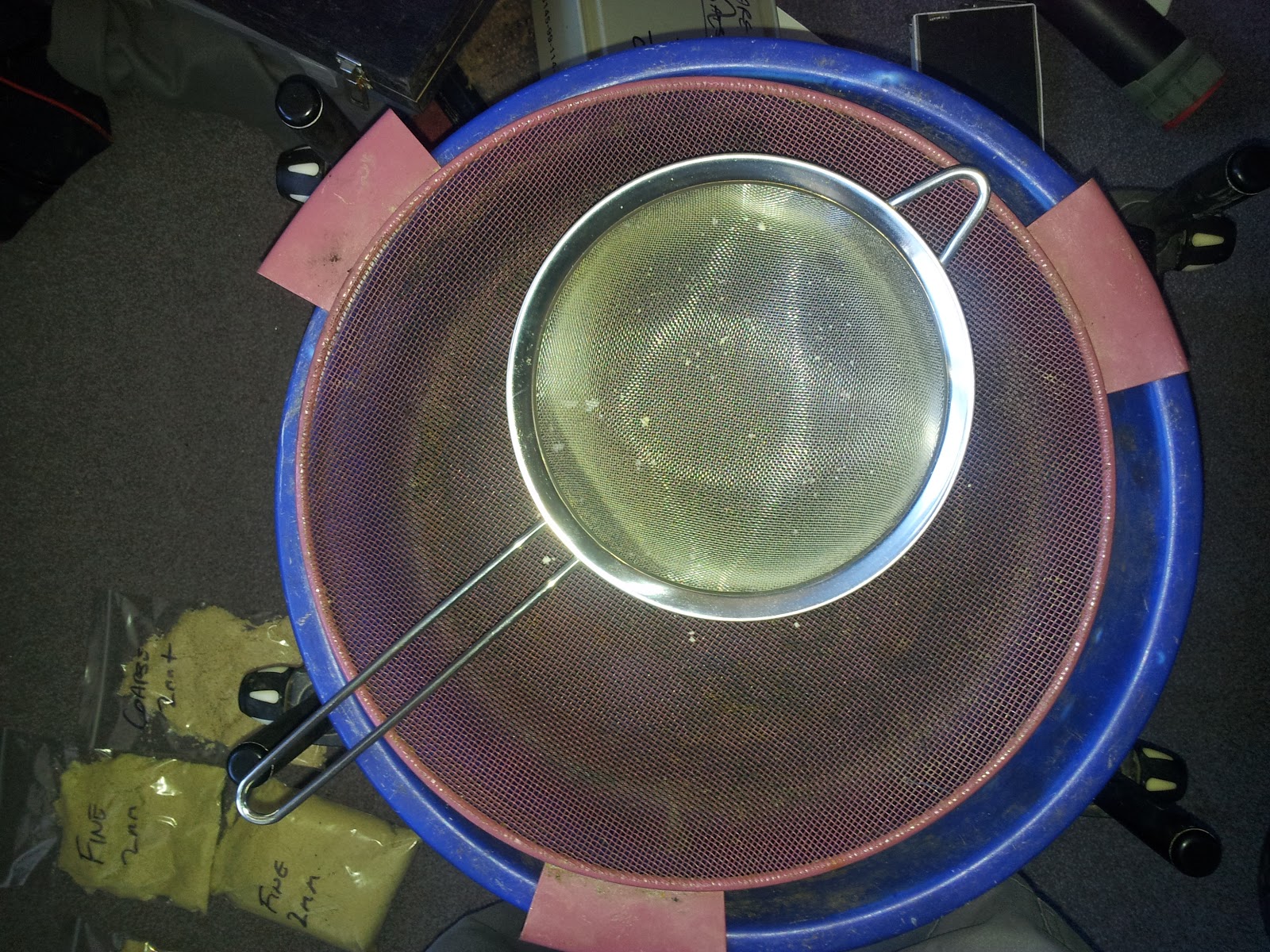
Once it is liquidised I will then pass it through
a 2mm riddle to take out all the large lumps
that could over feed the fish at this time of year:
 And you should be left with something that looks like this:
All the left over large lumps can be passed back through the food processor to try and get as much from the loaf as possible, and then riddled again. Anything that I cannot get smaller  will put into a bag and freeze for another day.
At this time I will also riddle a couple of handfuls through the flour sieve to make some super fine bread for super hard days. But you will be left with  something that looks a little like this:
These bags can be used straight away or, as I tend to do, place them in the freezer then they will become even finer. I hope that this helps your fishing in the future and I will be looking at tactics, rigs and feeding in later posts.
See you on the bank.